
Which Squarespace alternatives actually work for Central European businesses?
For visitor-based businesses in Central Europe, WordPress is the clear first choice among Squarespace alternatives. It offers full data ownership, a plugin ecosystem running to over 61,000 options, and the compliance flexibility that EU regulations demand. No other platform comes close for businesses that need multilingual content, GDPR controls, and room to grow.
Here are the strongest options worth considering:
- WordPress with WooCommerce — the open-source standard for custom, compliant, and scalable visitor-facing websites
- WordPress with WPML — adds professional multilingual support with SEO-optimised URLs per language
- WordPress with Polylang — a lighter multilingual plugin suited to smaller sites with fewer translation needs
- WordPress with TranslatePress — front-end visual translation interface, popular with content teams managing their own copy
- Ghost — a publishing-first platform suited to content-heavy operators, though it lacks e-commerce capability
- Hugo with Decap CMS — a static-site generator for technically confident teams wanting near-zero hosting costs
Data ownership is a deciding factor here. When you leave Squarespace, you can export blog posts and basic pages as an XML file, but your design, layout, product configurations, and SEO settings stay behind. WordPress gives you complete portability: your files, database, and content move with you intact to any host.
Why multilingual support matters more than Squarespace can deliver
Central European visitor-based businesses routinely serve audiences across multiple languages. A museum in Prague, a tour operator in Budapest, or a heritage site in Kraków cannot afford a site that treats multilingual content as an afterthought.
Squarespace has no native multilingual capability. The workarounds are either duplicating your entire site structure, which doubles your maintenance burden, or paying for a third-party service such as Weglot on top of your existing subscription. Neither approach produces clean, SEO-optimised language URLs.
WordPress handles this properly through three mature plugins:
- WPML — the most established option, with full WooCommerce compatibility and granular SEO control per language
- Polylang — free for core functionality, well-suited to sites with two or three languages and straightforward content
- TranslatePress — a front-end editor that lets non-technical staff translate content directly on the live page
Each plugin creates separate URL structures per language, which Google indexes independently. That means your German-language tour page and your English-language tour page each compete in their own language’s search results rather than cannibalising each other.
Pro Tip: If your team manages translations in-house rather than through a professional translator, TranslatePress is usually the easiest to operate. For sites with complex WooCommerce product catalogues, WPML’s dedicated e-commerce module is worth the additional cost.
GDPR compliance: why WordPress gives you more control
Neither Squarespace nor WordPress is inherently GDPR compliant by default. Compliance is a configuration task, not a feature you switch on. The difference is that WordPress lets you configure it precisely; Squarespace does not.
The most common compliance failure on visitor-facing sites is loading Google Analytics before a user has given consent. On WordPress, a certified Consent Management Platform gates all third-party scripts behind the consent banner. On Squarespace, that level of script control is not available on standard plans.
Key compliance considerations for Central European businesses:
- Consent gating — analytics and marketing scripts must not fire until the visitor actively accepts
- Data Privacy Framework certification — if you use US-based hosting or SaaS tools that process EU visitor data, DPF certification is the mechanism that covers the transfer
- Cookieless analytics options — tools like Matomo (self-hosted), Plausible, or Fathom process data without cross-border transfers, removing the consent-banner requirement for analytics entirely
- Data storage location — Squarespace stores data primarily on AWS infrastructure in the US, which creates additional transfer obligations under GDPR
WordPress’s advantage is not that it does compliance for you. It is that it gives you the access to do it properly, with the right plugins, hosting choices, and consent architecture.
Why professional WordPress development pays off long-term
Choosing WordPress means owning your platform outright. You choose your host, control your server configuration, and are never subject to a pricing change or feature removal decided by a third party. For a visitor-based business whose website is its primary booking and discovery channel, that matters.
Closed builders create a specific kind of trap. The ease of setup is real, but the ceiling arrives faster than most businesses expect. Need a custom booking integration? A membership area with tiered access? A product filter built around your specific inventory? If the platform’s built-in options do not cover it, your only choices are a workaround or a migration.
Professional agency-led WordPress development avoids that ceiling entirely. A bespoke build can accommodate complex integrations, custom post types, and accessibility requirements from day one, rather than retrofitting them later at greater cost. Managed WordPress hosting adds performance optimisation, nightly backups, staging environments, and security scanning that closed platforms simply do not offer at comparable price points.
Key advantages of professional WordPress development:
- Full control over hosting, caching, and server configuration
- Bespoke design with no template constraints
- WooCommerce integration for compliant, extensible e-commerce
- WCAG accessibility built in from the start, not bolted on
- Ongoing support and maintenance contracts covering updates, security, and compliance
- Complete data portability if you ever need to change hosts or agencies
The long-term cost picture also favours WordPress. Squarespace’s Core plan starts at $23 per month billed annually but renews at $36 per month, putting the three-year total at roughly €1,055 before any add-ons. Managed WordPress hosting with a reputable provider typically costs a fraction of that, leaving budget for professional development and ongoing support.
How to choose the right web design provider for visitor-based businesses
The provider matters as much as the platform. A WordPress site built without compliance expertise or accessibility knowledge creates legal exposure, not just a suboptimal user experience.
When evaluating providers, look for:
- Proven experience with visitor-centred businesses — museums, tour operators, heritage sites, and cultural venues have specific booking, accessibility, and multilingual needs
- WCAG accessibility commitment — the EU Web Accessibility Directive applies to public-sector bodies and increasingly influences private-sector expectations; a provider who builds to WCAG standards protects you now and later
- GDPR and compliance expertise — not just a checkbox, but active configuration of consent flows, data storage, and third-party script management
- Ongoing support and maintenance — a site launched without a maintenance plan degrades in security and performance within months
- Verifiable trust signals — client testimonials, industry programme approvals, and years of regional experience are concrete indicators, not marketing claims
Egg Design meets all of these criteria. With over 17 years of industry experience, an approved vendor position in Ireland’s Digital That Delivers programme, and a specific focus on visitor-based enterprises, the agency brings the kind of regional and sector knowledge that generalist builders cannot replicate. Their commitment to WCAG accessibility and GDPR compliance is built into every project, not offered as an optional extra.
For businesses that want a regional partner with complementary digital expertise, Ttoy Digital Agency is worth considering for scalable web development and compliance-focused projects across Central Europe.
Pro Tip: Ask any prospective provider how they handle consent management platform configuration and what their process is for WCAG auditing. A vague answer is a red flag. A provider with real compliance experience will give you a specific, process-driven response.
How Squarespace and WordPress compare on core features
| Feature | Squarespace | WordPress |
|---|---|---|
| Pricing model | Paid subscription (renews at $36/month) | Free software; pay for hosting only |
| Multilingual support | No native support; third-party add-ons required | Native via WPML, Polylang, TranslatePress |
| Plugin ecosystem | Squarespace extensions only | 61,000+ plugins in official directory |
| Data ownership | Partial export only; design stays behind | Full ownership; complete portability |
| GDPR compliance controls | Basic; limited script gating | Granular; full consent management possible |
| SEO control | Basic meta tags, clean URLs, no custom schema | Full control via Yoast SEO, Rank Math, and others |
| Hosting independence | Tied to Squarespace servers | Runs on any host you choose |
| E-commerce | Built-in, limited EU VAT configuration | WooCommerce with full EU VAT and compliance support |
| WCAG accessibility | Limited customisation | Full control via theme and plugin selection |
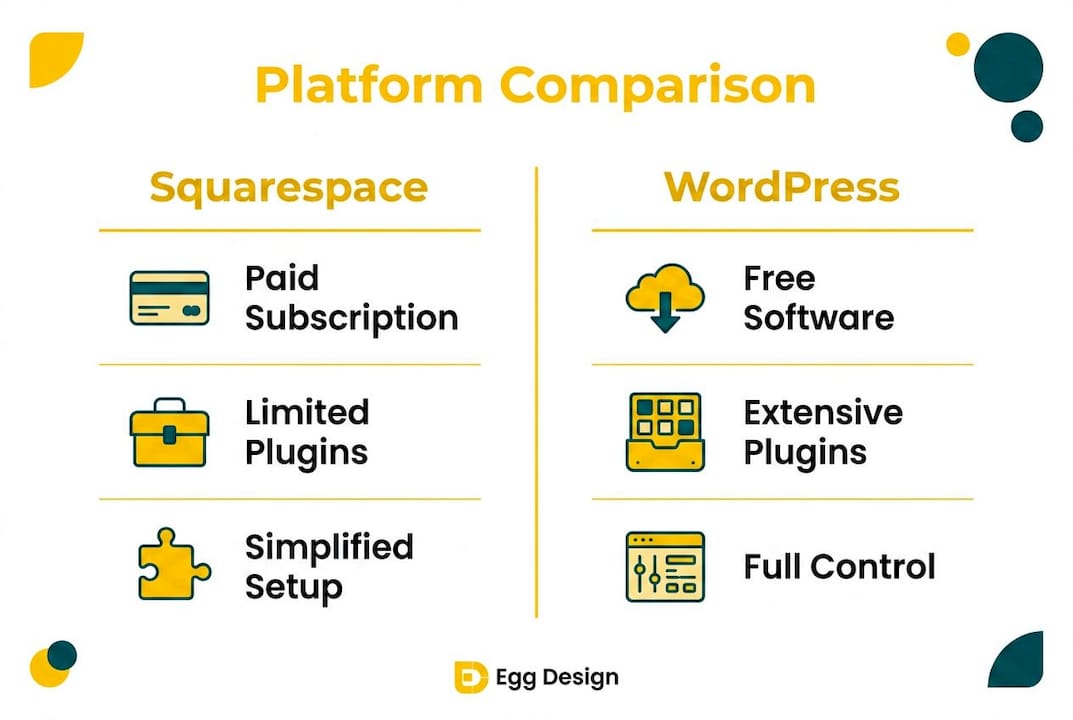
WordPress powers a large portion of all websites globally, significantly more than Squarespace. That gap reflects the ecosystem depth available to WordPress users when Google releases updates, new compliance requirements emerge, or a business needs a feature the platform did not originally offer.
WordPress plugins and platforms suited to visitor-based businesses
WordPress’s strength for visitor-based enterprises lies in how its plugin ecosystem maps directly onto the operational needs of museums, tour operators, and cultural venues.

WooCommerce handles ticket sales, membership products, and tour bookings with full EU VAT support and extensible checkout flows. It integrates with most major booking and CRM systems used in the visitor economy.
WPML and TranslatePress serve the multilingual demands covered earlier, but both also integrate with WooCommerce, meaning your product pages, checkout, and confirmation emails can all be translated and SEO-optimised per language.
Yoast SEO and Rank Math give content teams real-time feedback on page optimisation, schema markup for events and attractions, and sitemap control that Squarespace cannot match.
Gravity Forms and WPForms handle enquiry forms, group booking requests, and data capture with GDPR-compliant consent fields built in. You can gate form submissions behind explicit consent checkboxes and route data to EU-hosted CRM systems.
For e-commerce specifically, the WooCommerce platform gives visitor-based businesses far more control over pricing rules, VAT handling, and product configuration than Squarespace Commerce offers at any tier.
What does a WordPress site actually cost compared to Squarespace?
Cost comparisons between platforms often mislead because they compare the subscription price against the total WordPress cost. The honest comparison includes hosting, maintenance, and the value of what each platform can and cannot do.
Squarespace Core plans involve monthly fees billed annually and renew at a higher monthly rate, leading to a considerable total cost over multiple years, without nightly backups, staging environments, or plugin access.
Managed WordPress hosting from a reputable provider typically runs significantly less per year, and includes backups, staging, SSL, and the full plugin ecosystem. The professional development investment is a one-off cost that produces an asset you own outright, rather than a recurring fee for access to a platform you do not control.
The hidden cost of Squarespace is migration. When a business outgrows the platform, rebuilding on WordPress is effectively starting from scratch. Design, layout, product configurations, and SEO history do not transfer. Businesses that start on WordPress avoid that cost entirely.
WordPress SEO and performance versus Squarespace
WordPress gives you direct access to the technical levers that determine search performance. Squarespace handles the basics: title tags, meta descriptions, and clean URLs. But you cannot add custom schema markup, control your sitemap in detail, or install an SEO plugin that analyses content in real time.
Squarespace sites have a documented tendency to struggle with Largest Contentful Paint scores, often overshooting Google’s 2.5-second threshold because you cannot control responsive image delivery at the server level. On a properly configured WordPress stack with server-side caching, sub-second time to first byte is achievable consistently.
For visitor-based businesses competing for local and regional search traffic across multiple languages, that SEO gap compounds over time. Each language version of a WordPress page is independently indexed and optimised. Squarespace’s workarounds produce either duplicate content risks or a single-language SEO ceiling.
Egg Design builds the WordPress sites visitor-based businesses actually need
If you have been running on Squarespace and hitting its limits, or you are choosing a platform for the first time and want to get it right, Egg Design offers a direct path to a custom WordPress site built for the specific demands of visitor-based enterprises.
Egg Design’s WordPress development service covers bespoke design, WooCommerce integration, multilingual configuration, WCAG accessibility, and GDPR compliance, all under one roof. As an approved vendor in Ireland’s ‘Digital That Delivers’ programme with over 17 years of experience, the agency has the credentials and the sector knowledge to deliver sites that perform, comply, and grow with your business. Client testimonials consistently highlight the team’s responsiveness and their ability to translate specific business requirements into working digital solutions.
The difference from a generic builder or a generalist agency is specificity. Egg Design works with museums, tour companies, and visitor-centred businesses, so the questions around booking integrations, multilingual SEO, and accessibility compliance are ones they have answered many times before. Get in touch with Egg Design to discuss your project and find out what a purpose-built WordPress site can do for your business.